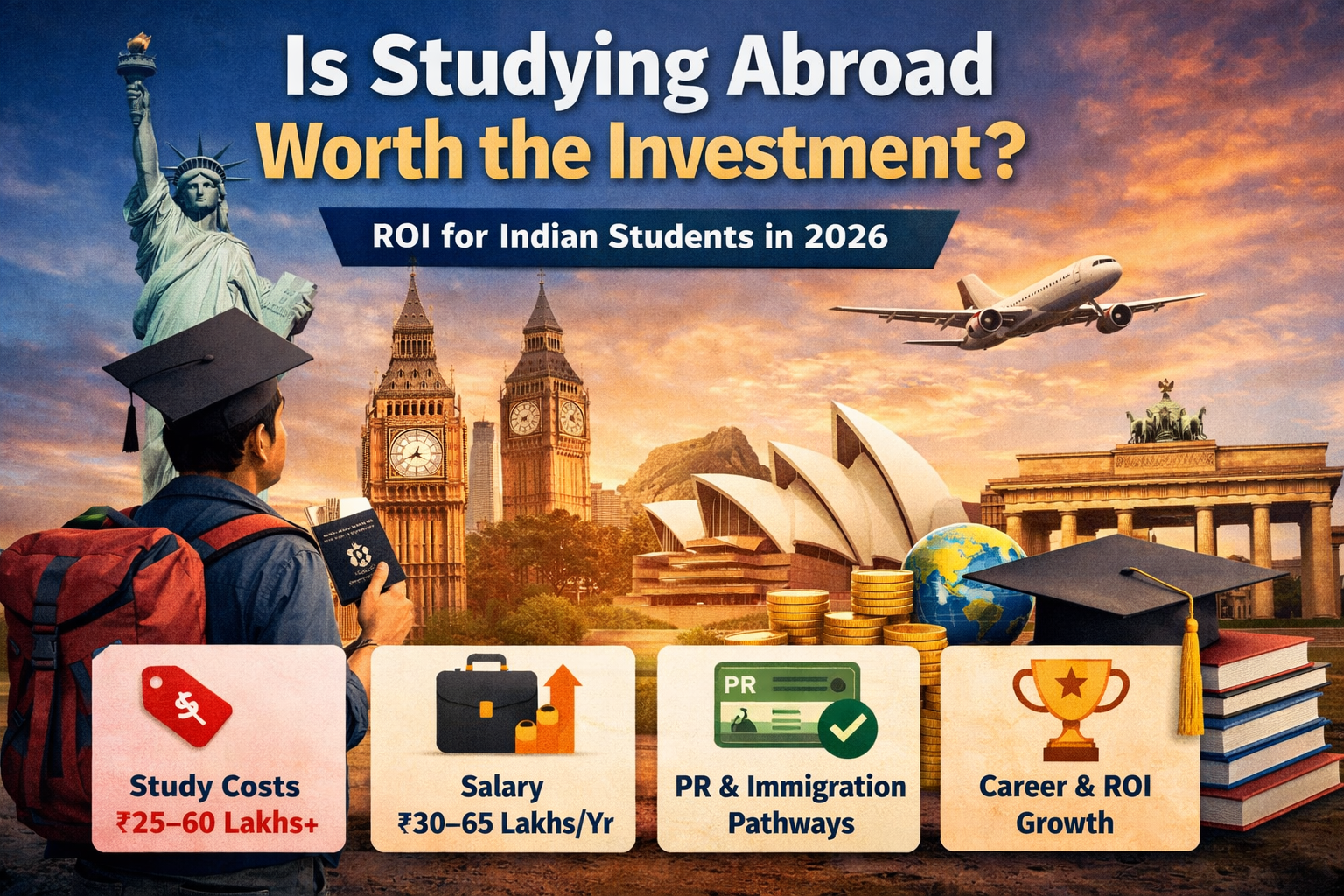
This is one of the most searched questions among Indian students:
“Is studying abroad worth the investment?”
You see classmates moving to Canada, the UK, Australia, Germany, or the USA. Social media shows exciting campus life and global careers.
But then reality hits:
💰 Expenses of ₹30–60 lakhs
💰 Education loans
💰 Currency exchange rates
So let’s answer this question logically, financially, and strategically.
This 2026 ROI guide covers:
✔ Cost of studying abroad
✔ Salary after studying abroad
✔ Payback period
✔ PR & immigration benefits
✔ Scholarships & cost reduction
✔ When studying abroad is NOT worth it
Understanding the ROI of Studying Abroad
ROI (Return on Investment) measures how beneficial your investment is.
Formula (Financial ROI):
ROI = (Gain – Cost) ÷ Cost
But the ROI of studying abroad for Indian students includes more than money:
• Career acceleration
• Global employability
• International exposure
• Immigration pathways
• Lifetime earning growth
Let’s break down both financial ROI and long-term value ROI.
Part 1: Cost of Studying Abroad in 2026
1️⃣ Tuition Fees (Average Estimates)
| Country | Annual Tuition Cost |
|---|---|
| Canada | ₹12–25 lakhs |
| UK | ₹15–30 lakhs |
| USA | ₹20–45 lakhs |
| Australia | ₹18–35 lakhs |
| Germany | ₹0–5 lakhs (public universities) |
Costs vary based on:
✔ Course (MBA & STEM cost more)
✔ University ranking
✔ Duration
✔ Location
2️⃣ Living Expenses (Yearly Average)
| Country | Living Cost |
|---|---|
| Canada | ₹8–12 lakhs |
| UK | ₹10–15 lakhs |
| Australia | ₹12–18 lakhs |
| Germany | ₹8–12 lakhs |
Metro cities like London, Sydney, Toronto cost more.
3️⃣ Total Investment (Master’s Degree)
| Country | Estimated Total Cost |
|---|---|
| Canada | ₹30–45 lakhs |
| UK | ₹30–50 lakhs |
| Australia | ₹40–60 lakhs |
| USA | ₹45–80 lakhs |
| Germany | ₹15–25 lakhs |
Includes tuition + living.
Part 2: Salary After Studying Abroad (2026 Outlook)
Average Starting Salaries
| Country | Avg Starting Salary |
|---|---|
| Canada | ₹35–60 lakhs/year |
| UK | ₹30–55 lakhs/year |
| Australia | ₹40–65 lakhs/year |
| USA | ₹60 lakhs – ₹1.2 Cr/year |
| Germany | ₹35–70 lakhs/year |
Highest paying fields:
✔ Data Science
✔ AI / ML
✔ Cybersecurity
✔ Healthcare
✔ Engineering
✔ Finance
Study Abroad vs India Salary Comparison
India (Typical Fresh Graduate):
₹6–15 lakhs/year
Top-tier Indian colleges:
₹20–30 lakhs average packages
Abroad (Typical Graduate):
₹35–65 lakhs/year
📈 The salary gap is substantial.
Part 3: How Long to Recover Study Abroad Costs?
Example ROI Scenario (Canada)
• Total Investment → ₹40 lakhs
• Starting Salary → ₹45 lakhs/year
After tax & expenses:
💵 Potential savings → ₹15–20 lakhs/year
Investment recovery period:
⏳ 2–3 years
After this → Positive ROI
Part 4: Non-Financial ROI (Hidden Advantages)
Many students underestimate this.
🌍 1. Global Work Experience
International exposure boosts:
✔ Resume strength
✔ Leadership potential
✔ Cross-cultural communication
✔ Global job eligibility
🛂 2. PR & Immigration Opportunities
Countries offering strong post-study options:
• Canada
• Australia
• Germany
Permanent Residency leads to:
📈 Higher salaries
📈 Job security
📈 Lifetime wealth growth
🤝 3. Professional Networks
You gain:
✔ International peers
✔ Alumni networks
✔ Industry contacts
These often unlock global job opportunities.
🧠 4. Personal Growth
Students develop:
✔ Independence
✔ Adaptability
✔ Confidence
✔ Problem-solving skills
These accelerate career success.
Part 5: When Studying Abroad May NOT Be Worth It
Studying abroad ROI depends on strategy, not hype.
Avoid if:
❌ Low-demand courses
❌ No career planning
❌ Blindly choosing universities
❌ Ignoring internships
❌ Taking unsustainable loans
Part 6: Best Countries to Study Abroad in 2026 (ROI-Focused)
Canada
✔ Strong PR pathways
✔ High employability
✔ Balanced cost vs salary
Germany
✔ Low / zero tuition
✔ Strong engineering & tech market
Australia
✔ High salaries
✔ PR opportunities
✔ Excellent lifestyle
UK
✔ 1-year master’s → faster ROI
✔ Graduate Route visa
USA
✔ Highest salary ceiling
✔ Best for STEM & tech
Part 7: How to Maximize ROI of Studying Abroad
✅ Step 1: Choose High-Demand Courses
Top ROI programs:
✔ Data Science
✔ AI / ML
✔ Cybersecurity
✔ Healthcare
✔ Engineering
✔ Finance
✅ Step 2: Select Employability-Focused Universities
Check:
✔ Graduate employment rate
✔ Internship programs
✔ Industry tie-ups
✅ Step 3: Apply for Scholarships
Scholarships reduce financial burden significantly.
Helpful resources:
• EduCanada
• Study in Australia
• DAAD Germany
✅ Step 4: Work Part-Time
Most countries allow:
⏰ 20–24 hrs/week
Helps offset living costs.
✅ Step 5: Prioritize Internships
Internships improve:
📈 Employability
📈 Salary offers
📈 PR eligibility
Part 8: Education Loans – Risk or Leverage?
Loans are not bad if ROI is strong.
If your salary increases 3–5×, the loan becomes:
✔ Strategic leverage
✔ Career accelerator
Smart loan tips:
✔ Compare interest rates
✔ Use moratorium wisely
✔ Calculate EMI vs salary
✔ Avoid lifestyle inflation
Frequently Asked Questions (FAQ)
❓ Is studying abroad worth the investment in 2026?
Yes — if chosen strategically. High-demand courses + employable countries = strong ROI.
❓ How long does it take to recover costs?
Typically 2–4 years post-graduation.
❓ Which country offers best ROI?
Canada, Germany, Australia (PR + jobs).
❓ Is an education loan risky?
Only without planning. With career strategy → manageable.
❓ Biggest mistake students make?
Choosing courses without job market research.
Final Verdict: Is Studying Abroad Worth It?
✔ Higher salaries
✔ Faster career growth
✔ Global mobility
✔ Better long-term earnings
But success depends on:
🎯 Course selection
🎯 Country choice
🎯 University employability
🎯 Career planning
Ready to Plan Your Study Abroad Journey?
📞 Book a Free Study Abroad Counselling Call
Get:
✔ Personalized ROI calculation
✔ Country comparison
✔ Course selection strategy
✔ Scholarship guidance
✔ Visa roadmap